
Royal Mail Parcel Sizes and Weight Limits: How to Choose the Right Postal Box
By Artsy Packaging · · Blog
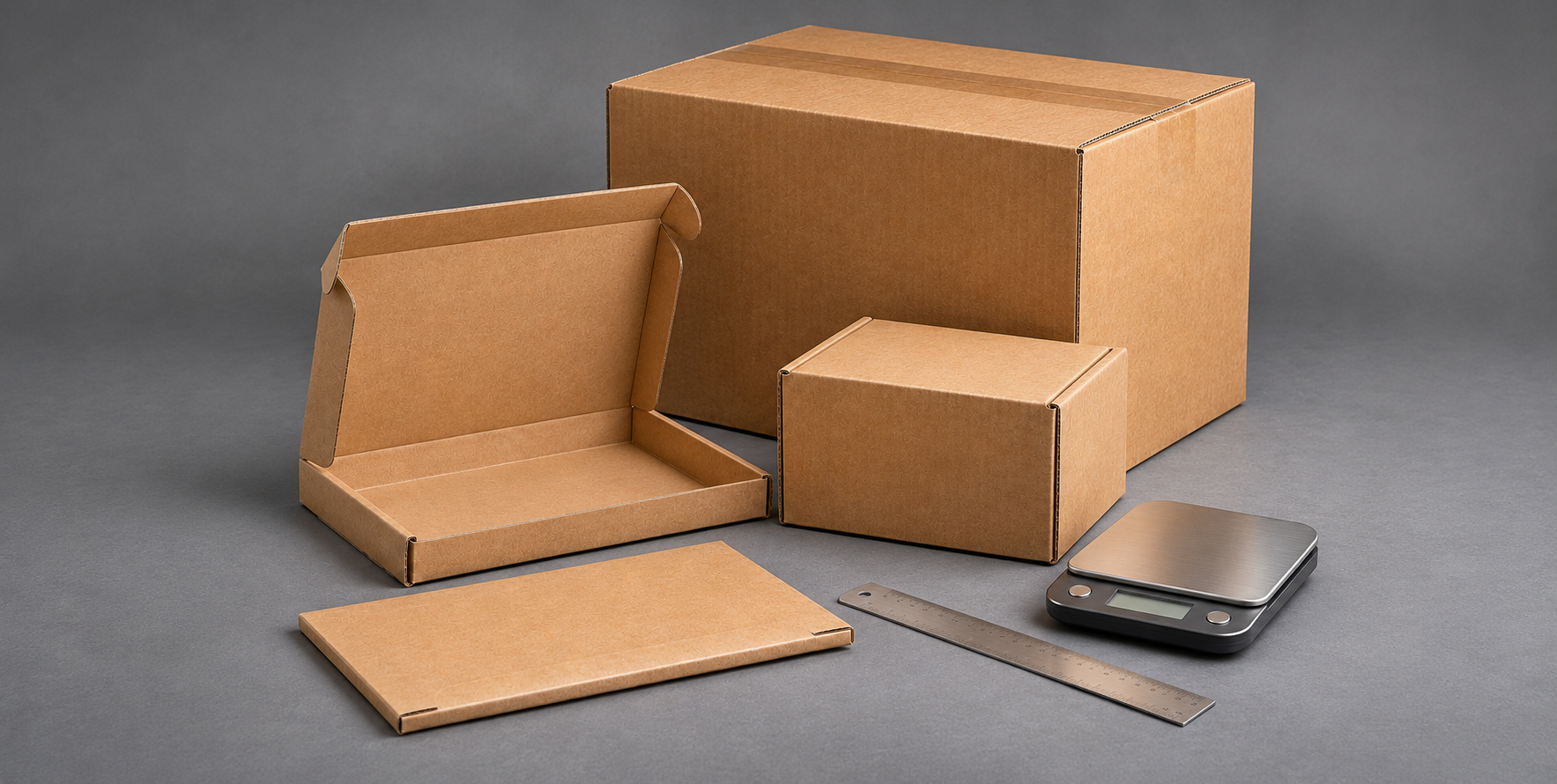
Choosing the wrong postal box can lead to incorrect postage, unexpected charges, or a parcel that exceeds Royal Mail's size and weight limits. Even when your product fits inside a box, the outer packaging can push the finished parcel beyond the permitted dimensions.
A few extra millimetres in depth or additional weight from cardboard and protective materials can move your shipment into a more expensive postage category. Without checking the finished parcel's measurements and weight, you could pay more for delivery than necessary or have to repackage the order before sending it.
This guide explains Royal Mail's parcel sizes and weight limits for each postal format, including Letters, Large Letters, Small Parcels, Medium Parcels and tubes. You'll also learn how to measure a packed parcel, calculate internal and external box dimensions, compare postage formats and choose a postal box that protects your product while keeping delivery costs under control.
Royal Mail Parcel Sizes and Weight Limits at a Glance
Royal Mail uses four main UK postal formats: Letter, Large Letter, Small Parcel and Medium Parcel. Each format has specific maximum length, width, depth and weight limits. Tubes and rolls follow a separate size calculation, while larger shipments may require a Parcelforce service.
The table below provides an overview of the main limits, typical items and suitable packaging options.
| Royal Mail format | Maximum dimensions (L × W × D) | Maximum weight | Typical items | Suitable packaging |
|---|---|---|---|---|
| Letter | 240 × 165 × 5 mm | 100 g | Letters, greeting cards, postcards and bills | Standard envelopes and flat mailers |
| Large Letter | 353 × 250 × 25 mm | 750 g* | A4 documents, magazines, certificates and thin products | Shallow postal boxes and rigid mailers |
| Small Parcel | 450 × 350 × 160 mm | 2 kg | Shoes, books, mobile phones and small boxed products | Small postal boxes and die-cut mailer boxes |
| Medium Parcel | 610 × 460 × 460 mm | 20 kg | Gifts, bulky homeware and multiple-item orders | Medium postal boxes and double-wall boxes |
| Tubes and rolls | Length + (2 × diameter) must not exceed 1,040 mm; the greatest dimension must not exceed 900 mm | 2 kg | Posters, rolled documents and prints | Postal tubes and protective roll packaging |
| Royal Mail express 24 / express 48 | Maximum length: 1,500 mm; maximum length + girth: 3,000 mm | 30 kg | Large, heavy or bulky shipments | Large shipping boxes and reinforced packaging |
| Royal Mail Express 48 large | Maximum length 2,500 mm; maximum length + girth 4,000 mm | 30 kg | Oversized and heavy shipments | Large shipping boxes and reinforced packaging |
Royal Mail Size and Weight Limits by Format
A Royal Mail item must meet both the maximum dimension and weight requirements for its selected postal format. Exceeding any one of these limits means the item no longer qualifies for that format and may need a different postage category or service. Always check the finished parcel's external dimensions and packed weight before buying postage.
Royal Mail Letter
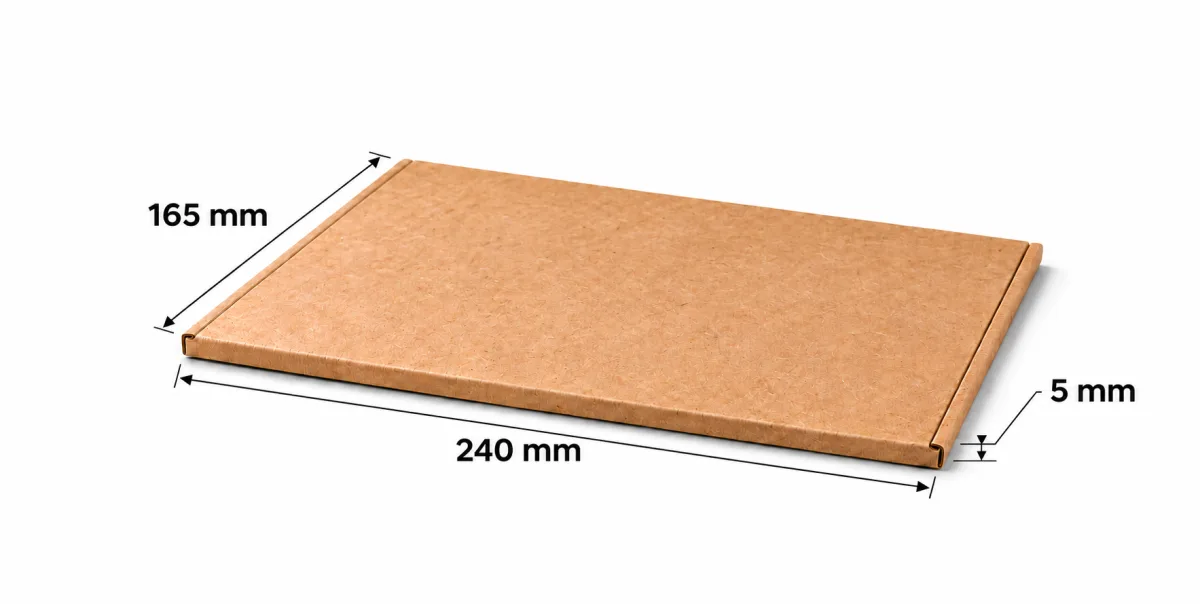
A Royal Mail Letter can measure up to 240 × 165 × 5 mm (24 × 16.5 × 0.5 cm) and weigh no more than 100 g. This format suits flat items such as folded documents, postcards, greeting cards, and other thin paper products. For example, a packed envelope measuring 220 × 150 × 4 mm and weighing 50 g falls within the letter limits.
Thickness is the main measurement to check when preparing a letter. Stiff inserts, uneven contents or bulky attachments can push the finished envelope beyond the 5 mm maximum thickness. Use a flat envelope, and check the completed item after inserting its contents to ensure it is within all three maximum dimensions.
Royal Mail Large Letter
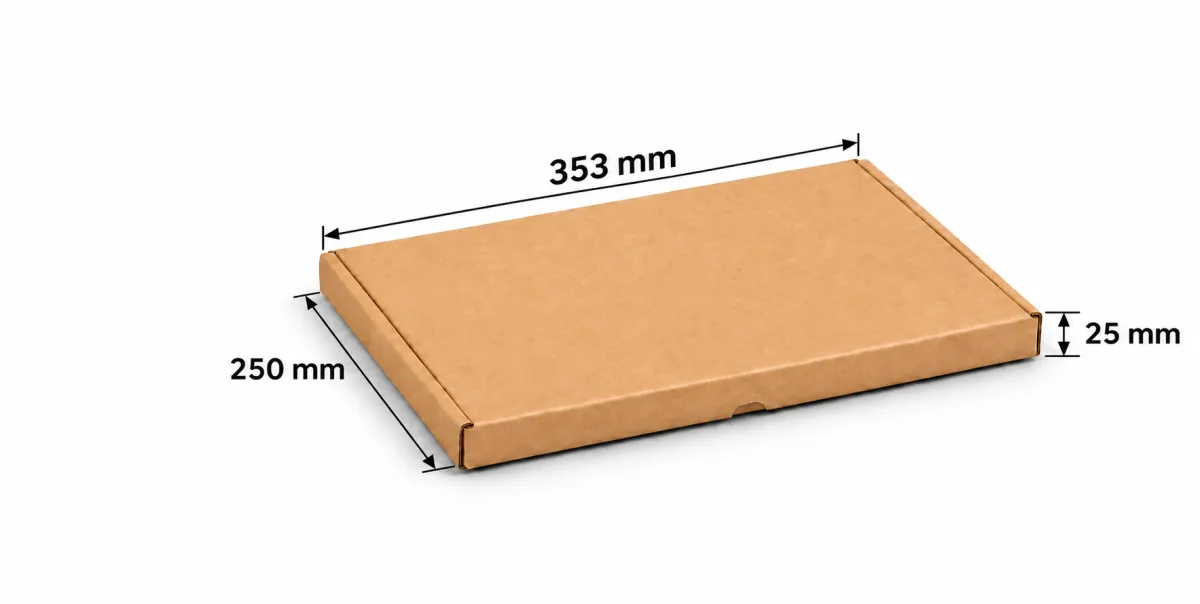
A Royal Mail Large Letter can measure up to 353 × 250 × 25 mm (35.3 × 25 × 2.5 cm). It is suitable for A4 documents, certificates, magazines, paperbacks, folded T-shirts, and small cosmetics that fit within these limits. For example, a packed item measuring 300 × 210 × 20 mm and weighing 300 g falls within the standard Large Letter limits.
The 25 mm maximum thickness is important when selecting packaging because the finished depth includes the contents and outer packaging. Measuring the contents alone can give an inaccurate result. A shallow postal box or board-backed envelope can provide suitable protection while keeping the finished item within the depth limit.
The maximum weight is 750 g for standard 1st and 2nd class large letters. Royal Mail Tracked 24 and Tracked 48 allow up to 1 kg.
Royal Mail Small Parcel
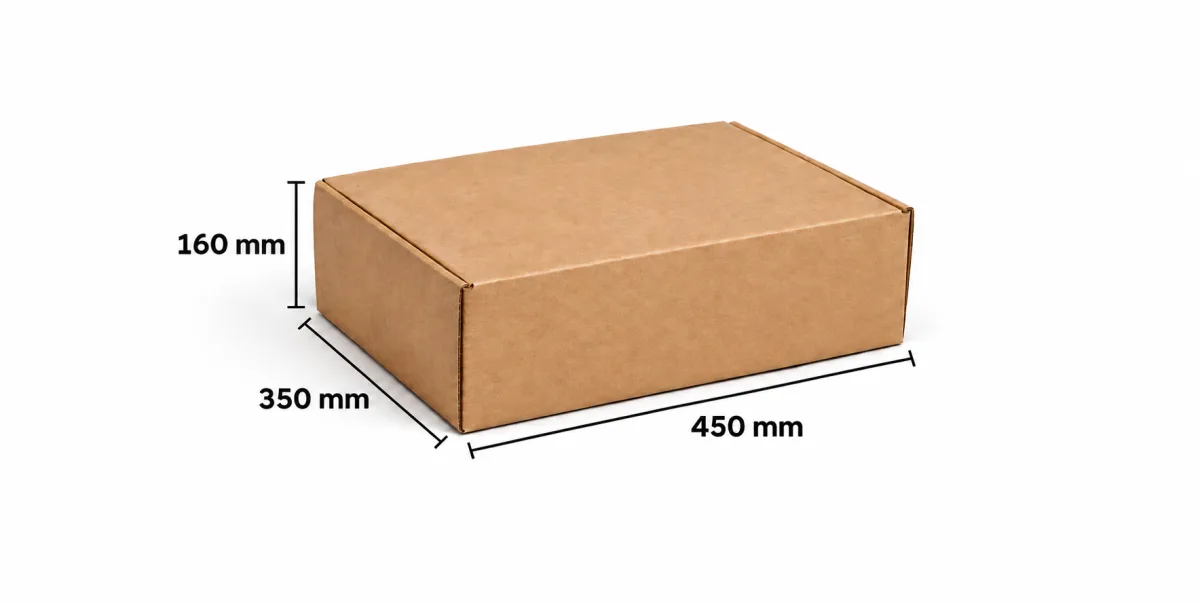
A Royal Mail Small Parcel can measure up to 450 × 350 × 160 mm (45 × 35 × 16 cm) and weigh no more than 2 kg. It suits items such as shoes, mobile phones, portable speakers and small boxed products. For example, a packed box measuring 300 × 220 × 120 mm and weighing 1.5 kg falls within the Small Parcel limits.
The main packaging consideration is the finished box size. Check its external length, width and depth after packing the product and adding protective materials. Choose a postal box that provides enough room for the contents without exceeding 450 × 350 × 160 mm or the 2 kg weight limit.
Royal Mail Medium Parcel
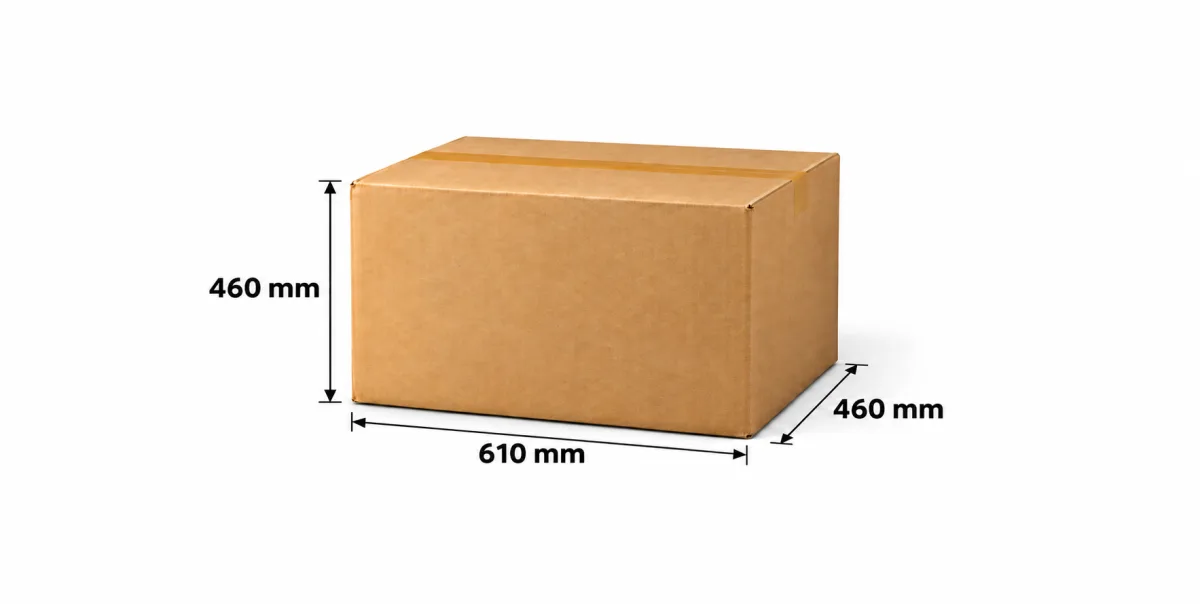
A Royal Mail Medium Parcel can measure up to 610 × 460 × 460 mm (61 × 46 × 46 cm) and weigh no more than 20 kg. This format suits larger shipments such as boots, gifts, homeware, bedding and multi-item orders. For example, a packed box measuring 500 × 350 × 300 mm and weighing 10 kg falls within the Medium Parcel limits.
These maximum dimensions are limits rather than recommended box sizes. Choose a box based on the contents and the space required for protective packaging, then check the finished external measurements. Heavier shipments may need stronger board construction to support the packed load and protect the contents during handling.
Royal Mail Tubes and Larger Parcels
Royal Mail tubes and rolls follow a separate size calculation. The length plus twice the diameter must not exceed 104 cm, and the greatest dimension must not exceed 90 cm. The maximum weight is 2 kg. This format suits posters, rolled documents and artwork that require cylindrical packaging rather than a rectangular postal box.
Items that exceed Royal Mail's Medium Parcel limits may need a Parcelforce service. Parcelforce Standard Parcels allow a maximum length of 1.5 m, a combined length and girth of 3 m and a maximum weight of 30 kg. Parcelforce Large Parcels allow a maximum length of 2.5 m, a combined length and girth of 4 m and a maximum weight of 30 kg.
Royal Mail Minimum Letter, Parcel and Tube Sizes
Royal Mail specifies minimum dimensions for letters, parcels and postal rolls. These requirements are important when sending small items such as jewellery, spare parts and accessories, as the fully packed item must meet the relevant minimum size.
The minimum dimensions for each format are given below.
| Format | Minimum size |
|---|---|
| Letter | 9 × 14 cm |
| Parcel | 10.5 × 14.8 cm |
How Royal Mail Measures Your Parcel
Royal Mail measures the finished, sealed parcel, including its outer packaging, rather than the product inside. These measurements determine the correct postage format and help prevent incorrect postage charges or delivery issues. Use a ruler or tape measure to check the parcel's external dimensions.
Follow these steps to measure your parcel accurately:
- Seal the parcel before measuring. Place the product inside, add the necessary protective materials, close the box, and secure it with tape. Take measurements only after the package is ready for posting.
- Measure all three dimensions. Record the length, width, and depth using the external edges of the package. For a standard rectangular box, length is generally the longest side, width is the next measurement, and depth is the shortest.
- Check the widest points. Include any bulges, protruding closures, or uneven areas that extend beyond the main body of the parcel when checking its overall dimensions.
- Account for irregular shapes. Measure the greatest external length, width, and depth of the packed item. Tubes and rolls follow a separate measurement rule based on their length and diameter.
Measuring tip: Where possible, leave a few millimetres below the maximum size limit. This provides a practical safety margin against small measurement differences and is not an additional Royal Mail requirement.
How strict is Royal Mail on parcel sizes?
Royal Mail checks the size and weight of the finished parcel against the limits of its selected format. If a parcel exceeds the limits of its selected format, it may need to be sent using a different postage category or service. The postage price may increase, and any additional charges will depend on Royal Mail's rules for the service and posting method.
Pay particular attention to parcels close to the size limit. For example, a large letter must not exceed 25 mm in depth. Extra packaging, tape or bulging contents can push it over this limit.
Does Royal Mail measure the box size or the final parcel size?
Royal Mail measures the finished parcel's external dimensions, including the box and all outer packaging, rather than just the product or empty box.
For example, a product with a depth of 20 mm will become thicker once the box material and protective wrapping are added. Measure the sealed package to ensure its final depth stays within the applicable size limit.
Royal Mail Weight Limits and Postage Services
Royal Mail weight limits vary according to the postal format and delivery service. Letters, Large Letters, Small Parcels and Medium Parcels have different maximum weight allowances. Services such as Tracked 24, Tracked 48 and Special Delivery Guaranteed also have specific weight limits.
Weigh the complete package before purchasing postage. Include the product, box, protective inserts, void fill, tape, and postage label.
Calculate the total packed weight using this formula:
Packed weight = Product + Box + Void fill + Tape + Label
Packaging materials contribute to the overall parcel weight and can affect the postage category you qualify for. The board grade and box construction also matter because thicker or heavier cardboard can increase the finished package weight.
The following table summarises the main UK Royal Mail weight limits and the conditions attached to each format or service:
| Format or service | Maximum weight | Service condition |
|---|---|---|
| Letter – 1st and 2nd Class | 100 g | Standard weight limit for both classes |
| Large Letter – 1st and 2nd Class | 750 g | Standard weight limit for both classes |
| Large Letter – Tracked 24 and Tracked 48 | 1 kg | Higher allowance than standard Large Letters |
| Small Parcel – Standard and Tracked | 2 kg | Maximum weight for the small parcel format |
| Medium Parcel – Standard and Tracked | 20 kg | Maximum weight for the medium parcel format |
| Tubes and rolls | 2 kg | Separate size calculation applies |
| Special delivery guaranteed by 9 am | 2 kg | Separate weight limit for this service |
| Special Delivery Guaranteed by 1 pm | 20 kg | Separate weight limit for this service |
Royal Mail Parcel Postboxes accept eligible prepaid parcels within their specified size and weight restrictions. Check the current acceptance limits before using one, as these may differ from the standard Small Parcel limits.
Are Royal Mail weight limits different online and at the post office?
Royal Mail's standard 1st and 2nd Class weight limits are the same whether postage is purchased online or at a post office branch. However, services such as Tracked 24, Tracked 48 and Special Delivery Guaranteed have their own weight allowances. Check the conditions for your chosen service rather than assuming that purchasing postage online automatically increases the permitted weight.
Internal vs External Box Dimensions
Internal dimensions measure the usable space inside a postal box, while external dimensions measure its overall size from the outside. Royal Mail checks the external dimensions of the finished parcel against its postal size limits.
The difference comes from cardboard thickness. A single-wall board has one fluted layer, while a double-wall board has two. A thicker board increases the box's external length, width, and height without increasing its internal capacity.
Use this formula to estimate each external dimension:
External dimension = Internal dimension + (2 × board thickness)
For example, a box with internal dimensions of 300 × 200 × 100 mm and 3 mm-thick board has approximate external dimensions of 306 × 206 × 106 mm. Actual measurements may vary depending on the box construction and manufacturing tolerances.
Large Letter vs Small Parcel
Royal Mail Large Letters and Small Parcels have different size and weight limits. The key difference is depth: a large letter can be up to 25 mm thick, while a small parcel can be up to 160 mm deep. The finished, packed box must meet the maximum length, width, depth, and weight for its postage format.
Packaging alone can move an item from Large Letter to Small Parcel. For example, the same paperback could qualify as a Large Letter in a flat postal box measuring 300 × 210 × 20 mm, provided its packed weight does not exceed 750 g. Pack it in a 300 × 210 × 50 mm box, and it exceeds the 25 mm depth limit. It would need to use the small parcel format, provided it meets the other size limits and the 2 kg weight limit.
The following table compares the Royal Mail Large Letter and Small Parcel limits and suitable packaging:
| Feature | Large Letter | Small Parcel |
|---|---|---|
| Maximum size | 353 × 250 × 25 mm | 450 × 350 × 160 mm |
| Maximum weight | 750 g (1 kg for Tracked 24 and Tracked 48) | 2 kg |
| Maximum depth | 25 mm | 160 mm |
| Typical items | Paperback books, documents, magazines and thin accessories | Shoes, mobile phones, clothing and boxed products |
| Pricing behaviour | Price depends on packed weight and postage service. | Price depends on packed weight and postage service. |
| Suitable box | Flat postal box or shallow PIP box | Deeper postal box with space for the product and protective packaging |
What is PIP (Pricing in Proportion)?
Pricing in Proportion (PIP) is Royal Mail's pricing approach for Letters, Large Letters and Small Parcels. It uses the item's size and weight to determine the applicable postage format and price.
A PIP box is a shallow postal box designed to fit within a specific size limit, commonly the 25 mm large-letter depth limit. However, using a PIP box does not guarantee large-letter postage. Check its external dimensions after packing and its total weight against Royal Mail's large letter limits.
Small Parcel vs Medium Parcel
Royal Mail Small Parcels can measure up to 450 × 350 × 160 mm and weigh up to 2 kg. Medium Parcels allow larger dimensions of 610 × 460 × 460 mm and a maximum weight of 20 kg. A parcel that exceeds the small parcel dimensions or 2 kg weight limit may qualify as a medium parcel if its external dimensions and packed weight remain within the medium parcel limits and it meets the chosen service's conditions.
The following table compares the maximum external dimensions and packed weight for each Royal Mail parcel format:
| Limit | Small Parcel | Medium Parcel |
|---|---|---|
| Maximum length | 450 mm | 610 mm |
| Maximum width | 350 mm | 460 mm |
| Maximum depth | 160 mm | 460 mm |
| Maximum weight | 2 kg | 20 kg |
How to Choose the Right Postal Box
Choose a Royal Mail postal box by measuring your product, allowing space for protection, calculating the finished box dimensions and weight, then matching them to the relevant postage format.
Follow these steps to select a box that accommodates your product and meets Royal Mail's size and weight limits.
- Measure the product. Measure the product's length, width and depth before adding protective materials. Record the largest measurements, particularly for irregularly shaped items.
- Allow space for protection. Work out how much room the product needs for cushioning, wrapping, or inserts. The required clearance depends on the product and its protection needs. Fragile items generally need more protective space than durable products.
- Calculate the internal dimensions. Add the required protective clearance to the product's length, width, and depth. For example, allowing 10 mm of clearance on each side adds 20 mm to the corresponding internal box dimension.
- Calculate the external dimensions. Account for the cardboard thickness and box construction. As a general estimate, add twice the board thickness to each internal dimension. The finished box's actual external measurements may vary depending on its construction.
- Weigh the packed parcel. Include the product, box, protective inserts, void fill, tape, and label. This gives you the total packed weight for checking the relevant postage allowance.
- Match the parcel to a Royal Mail format. Compare all three external dimensions and the packed weight with the limits for your chosen service. The parcel must meet every applicable size and weight requirement.
- Test a sample before ordering in bulk. Pack and seal one box, then check its external dimensions and total weight. Confirm that the product fits securely and the finished parcel meets the relevant postage limits before finalising the box specification.
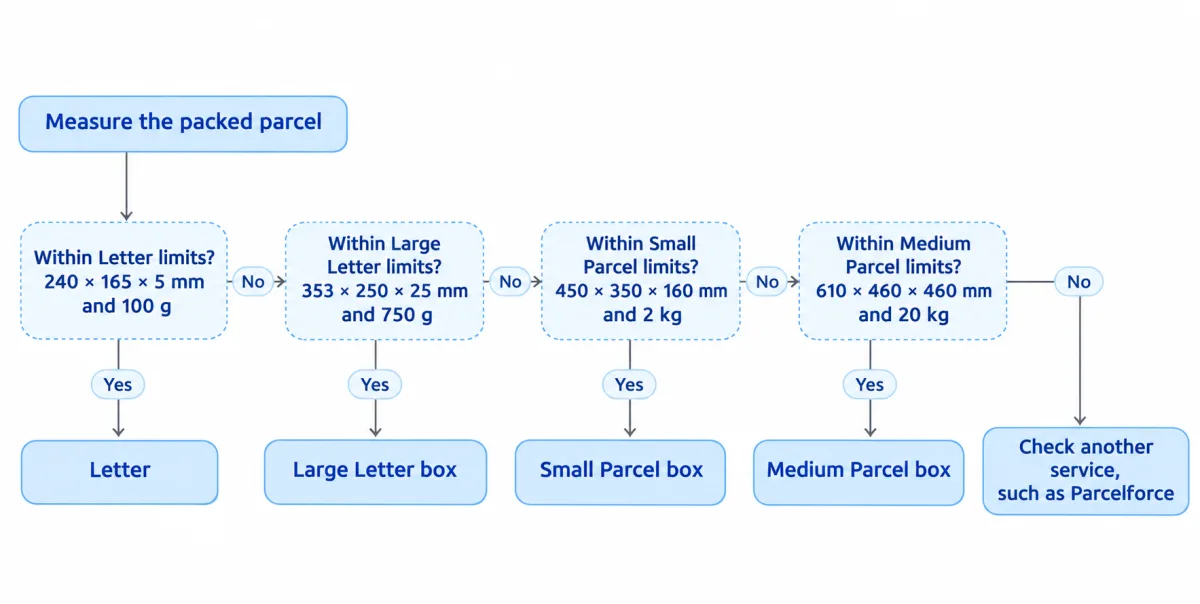
Decision tree: which Royal Mail format does my parcel fit?
Use this decision tree to identify the suitable Royal Mail format. Check all three external dimensions and the total packed weight at every stage. The large letter weight limit depends on the service selected.
Postal box selection matrix
These examples show how packed products may fit Royal Mail's postage formats. Dimensions and weights are illustrative; measure your packed items before choosing a box.
| Item | Example packed dimensions | Example packed weight | Royal Mail format | Suggested box |
|---|---|---|---|---|
| A4 documents | 320 × 230 × 15 mm | 450 g | Large Letter | Flat document postal box |
| Small cosmetics | 180 × 120 × 70 mm | 350 g | Small Parcel | Small postal box with protective inserts |
| Paperback book | 230 × 155 × 25 mm | 350 g | Large Letter | Shallow book postal box |
| Folded T-shirt | 280 × 220 × 35 mm | 200 g | Small Parcel | Shallow postal box or mailing box |
| Boxed shoes | 340 × 230 × 130 mm | 1.1 kg | Small Parcel | Shoe postal box |
| Multi-item order | 400 × 300 × 200 mm | 3 kg | Medium Parcel | Medium postal box |
Single Wall vs Double Wall vs Crash Lock Boxes
Choosing a postal box involves more than comparing strength. Board construction affects product protection, parcel weight, and external dimensions, while box design affects assembly and packing speed. 'Single-wall' and 'double-wall' describe corrugated board construction, whereas 'crash-lock' and 'die-cut' describe box design and manufacturing features. These features can overlap rather than being mutually exclusive options.
The table compares their construction and typical packaging applications.
| Box type | Construction | Strength | Weight impact | Best for | Typical product |
|---|---|---|---|---|---|
| Single wall | One corrugated fluted layer between two flat liners | Provides standard protection for lightweight and moderately heavy products | Generally lighter and thinner than comparable double-wall board | Everyday shipping where standard protection is sufficient | Clothing, books and small household products |
| Double wall | Two corrugated fluted layers with three flat liners | Offers greater cushioning and crush resistance than a comparable single-wall board | Generally adds weight and thickness | Heavier, fragile or stacked products requiring extra protection | Electronics, ceramics and multiple-item orders |
| Crash lock | Pre-glued base that folds and locks into position when opened; available in different board grades | Depends on the board grade and box construction. | Depends on the material and dimensions. | Faster box assembly and frequent order packing | Cosmetics, accessories and subscription products |
| Die-cut postal box | Cut and creased into a specific shape, usually with folding panels and tuck-in or locking flaps | Depends on the board grade and structural design. | Depends on the material, size and construction | Close-fitting postal packaging with a secure closure | Books, clothing and small accessories |
Royal Mail Postage Prices: How Size and Weight Affect Cost
Royal Mail postage costs depend on the parcel's size format, packed weight and chosen delivery service. External dimensions determine whether an item qualifies as a Letter, Large Letter, Small Parcel or Medium Parcel, while packed weight determines its applicable weight band.
Packaging can increase postage costs by changing the parcel's size or weight category. For example, a deeper box can move a paperback from Large Letter to Small Parcel, even if the product remains unchanged. Heavier cardboard and protective materials can also increase the packed weight.
The chosen service, such as 1st Class, 2nd Class or Tracked 24, also affects the price. Online postage can be cheaper for some Royal Mail services, while other products have the same price online and at a post office branch. Compare the current rates for your chosen service before buying postage, and select the lightest box that provides adequate protection without exceeding the relevant size limits.
Can I put two 2nd-class stamps on a large letter?
Yes, two 2nd Class stamps can cover a large letter weighing up to 100 g. Each stamp is worth 91p, giving a combined postage value of £1.82, which covers the £1.55 rate. However, the next weight band, up to 250 g, costs £1.90, so two stamps are not sufficient.
Is it cheaper to send one big parcel or two smaller ones?
It depends on Royal Mail's size and weight bands, postage rates, and packaging costs. Compare the total postage for both options before deciding.
For example, a 3 kg medium parcel sent by 2nd Class using October 2026 post office rates costs £9.50. Sending the same consignment as two 1.5 kg small parcels costs £9.20 (£4.60 each), saving 30p in postage.
How to Reduce Postage Costs with Right-Sized Packaging
Right-sized packaging helps reduce Royal Mail postage costs by keeping the finished parcel within the smallest suitable size and weight category. Oversized boxes, unnecessary cushioning and heavy packaging can increase parcel dimensions or packed weight, resulting in higher postage charges.
Use these practical packaging methods to control your postage costs:
- Keep suitable flat products within the 25 mm Large letter depth limit: Use shallow postal boxes or book wraps for products that fit this format. Check the finished parcel's dimensions and weight before purchasing postage.
- Keep Small Parcels within 2 kg: Weigh the product, box, inserts, and protective materials together. The finished parcel must also remain within 450 × 350 × 160 mm.
- Use lightweight protective materials: Choose suitable paper cushioning, lightweight inserts, or other protective void fill that secures the product without adding unnecessary weight or bulk.
- Choose an appropriate board grade: Match the board construction to the product's weight, fragility, and protection requirements. Avoid unnecessarily heavy boards, but do not compromise the protection needed during transit.
- Standardise two or three box sizes: Select a small range of box dimensions for your most common product sizes. This helps reduce unused space, avoid oversized packaging and simplify stock management.
- Store boxes flat-packed: Keep unused boxes flat until an order is ready for dispatch. This reduces storage space and makes packaging stock easier to organise.
Common Royal Mail Packaging Mistakes
Incorrect measurements, excessive packaging weight and unsuitable box designs can move a parcel into a more expensive Royal Mail postage category. Avoid these common mistakes when selecting postal boxes and preparing parcels for delivery:
- Measuring the product instead of the packed parcel: The finished package may exceed a Royal Mail size limit. Always measure the complete parcel, including the box and protective materials.
- Ignoring cardboard thickness: A product may fit the internal box dimensions, but the cardboard increases the external measurements. Check the finished box dimensions against the relevant postal limits.
- Ignoring the packed weight: The product may meet a weight limit on its own, but the box, inserts, and protective materials can push the parcel over the allowance. Weigh the complete package before purchasing postage.
- Using an oversized box: Excess space can require more cushioning and increase packaging weight. Select a box that accommodates the product and necessary protection without unnecessary empty space.
- Allowing contents to bulge: Overfilled mailers and protruding contents can increase the parcel's final dimensions, potentially exceeding the 25 mm large letter thickness limit.
- Assuming a PIP box guarantees a postage format: A Pricing in Proportion (PIP) box does not automatically qualify as a Large Letter or Small Parcel. Check its final external dimensions and packed weight against the relevant limits.
- Skipping a sample packing test: An empty box may appear suitable but exceed the size or weight limits once the product and protective materials are added. Pack a sample, check its external dimensions and weigh it before ordering packaging in bulk.
Frequently Asked Questions
What are the sizes of Royal Mail parcel boxes?
Royal Mail's four main UK formats are Letter (240 × 165 × 5 mm), Large Letter (353 × 250 × 25 mm), Small Parcel (450 × 350 × 160 mm) and Medium Parcel (610 × 460 × 460 mm). These are the maximum dimensions for the complete packed item. Each format also has a weight limit that must be met.
What is the minimum size for a Royal Mail parcel?
The minimum size for a Royal Mail parcel is 10.5 × 14.8 cm. Letters must measure at least 9 × 14 cm. Postal rolls have a separate requirement: their length plus twice the diameter must be at least 17 cm, and their length must be at least 10 cm.
What is a Royal Mail Large Letter?
A Royal Mail Large Letter is a flat item or package measuring no more than 353 × 250 × 25 mm. Its maximum weight is 750 g for standard 1st and 2nd Class services, while Tracked 24 and Tracked 48 allow up to 1 kg. Pricing in Proportion (PIP) uses the item's size and weight to determine the applicable postage price.
What box fits a Royal Mail Small Parcel?
Choose a postal box with enough internal space for your product and protective materials while keeping its external dimensions within 450 × 350 × 160 mm. For example, a shoe box must accommodate the shoes and any protective inserts without exceeding the Small Parcel limits when fully packed.
Can a parcel over 2 kg still be a small parcel?
No. Royal Mail Small Parcels have a maximum packed weight of 2 kg. A parcel weighing more than 2 kg must use the Medium Parcel format if its external dimensions do not exceed 610 × 460 × 460 mm and it meets the relevant service requirements.