 Apparel Boxes
 Candle Boxes
 Bakery Boxes
 Cbd Boxes
 Medical Boxes
 Automotive Boxes
 Jewellery Boxes
 Cannabis Boxes
 Xmas Boxes
 Cosmetic Boxes
 Gift Boxes
 Hemp Boxes
 Vape Boxes
 Retail Boxes
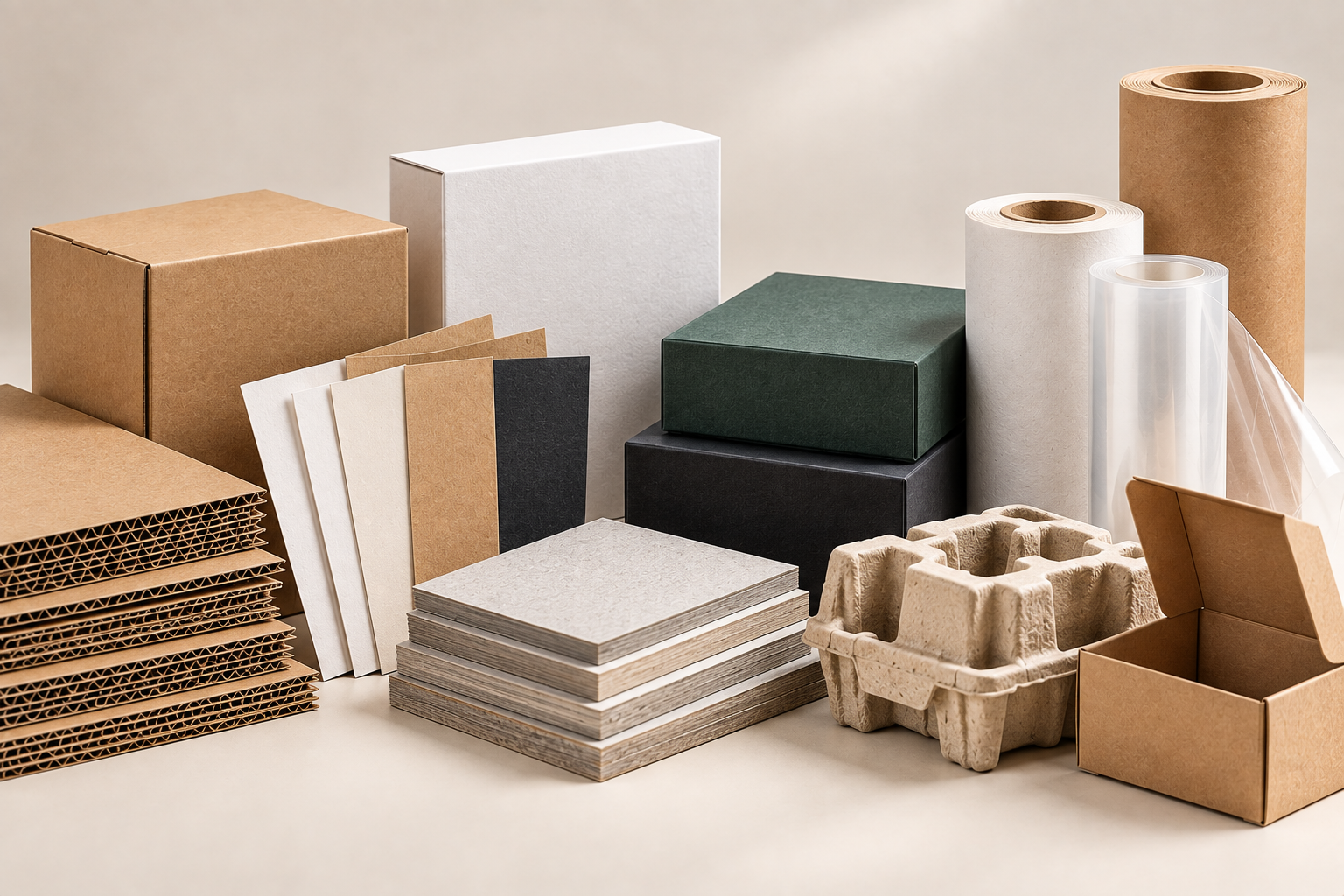
Packaging materials are used to contain, protect, preserve, transport, store, and present products. Common types include paper and paperboard, corrugated fibreboard, Kraft paper, plastics, glass, metal, wood, moulded pulp, and bio-based or compostable materials. Each material has different properties, including mechanical strength, thermal behaviour, gas barrier performance, optical properties, moisture resistance, and weight.
These properties influence how packaging materials perform in different applications. Corrugated fibreboard provides structural strength for shipping and stacking, while paperboard is commonly used for folding cartons and retail packaging. Kraft paper combines strength with a natural appearance, while rigid board provides a more substantial structure for premium packaging. Plastics offer versatility and barrier protection, whereas glass and metal provide durability and strong barrier performance. Moulded pulp provides lightweight cushioning and shaped protection.
Choosing the right packaging material depends on factors such as product weight and fragility, required protection, moisture and heat exposure, cost, appearance, regulatory requirements, and end-of-life options. The right material should provide the required protection and performance while meeting your practical, presentation, regulatory, and en”…making it suitable for shipping boxes, mailer boxes, retail packaging, and protective packaging.”
- “This packaging material is used for making bags, wrapping, pouches, sacks, protective packaging, and Kraft mailer boxes.”
- “Grey chipboard is commonly used as the structural core of rigid boxes, which may then be covered or laminated…”
- “These m
vironmental needs.
What Is a Packaging Material?
Packaging materials are materials used to make packaging boxes, bags, labels, stickers, cartons, wrappers, bottles, and other packaging formats and components that contain, protect, preserve, transport, store, and present products. Common packaging materials include paper and paperboard, corrugated fibreboard, plastics, glass, metal, and wood, along with fibre-based, bio-based, biodegradable, and compostable materials and constructions. Each material has different properties, including strength, flexibility, durability, weight, barrier performance, moisture resistance, printability, and end-of-life characteristics.
What Are the Main Types of Packaging Materials?
The main types of packaging materials include paper and paperboard, corrugated fibreboard, plastics, glass, metal, wood, moulded pulp, and bio-based or compostable materials. Each type has different strengths, barrier performance, weight, printability, durability, cost, and end-of-life characteristics, making it suitable for different products and packaging applications.
The following are the main types of packaging materials and their common grades, properties, and applications.
Corrugated Fibreboard
Corrugated fibreboard is a paper-based packaging material made from fluted paper, known as the corrugating medium, bonded between one or more flat linerboards. It is classified by both board construction and flute profile. Board construction describes the number and arrangement of fluted mediums and linerboards; common types include single-wall, double-wall, and triple-wall boards.
The flute profile describes the size and spacing of the flutes, with common profiles including A, B, C, E, and F flutes. Each type of corrugated fibreboard offers different levels of cushioning, stacking strength, crush resistance, structural performance, and printability. Corrugated fibreboard is lightweight, strong, recyclable, and cost-effective, making it suitable for shipping boxes, mailer boxes, retail packaging, and protective packaging.
Corrugated Fibreboard Constructions
The main types of corrugated fibreboard are outlined below, with each construction differing in its layer arrangement, strength, cushioning, and structural performance.
- Single-Face Corrugated Fibreboard: Single-face corrugated fibreboard combines one fluted medium with a single linerboard. Its lightweight, flexible construction makes it suitable for wrapping, cushioning, and protective packaging.
- Single-Wall Corrugated Fibreboard: Single-wall corrugated fibreboard features one fluted medium sandwiched between two linerboards. This construction offers a practical balance of strength and cushioning for shipping and general packaging.
- Double-Wall Corrugated Fibreboard: Double-wall corrugated fibreboard contains two fluted mediums separated by a linerboard and enclosed by two outer linerboards. The additional fluted layer increases its strength and stacking resistance, making it suitable for heavier packaging.
- Triple-Wall Corrugated Fibreboard: Triple-wall corrugated fibreboard is built with three fluted mediums and four linerboards, creating a substantially thicker and more rigid board. It is used where packaging requires high structural strength and greater load-bearing capacity.
- Honeycomb Corrugated Board: Honeycomb corrugated board uses paper layers arranged into a cellular honeycomb structure rather than conventional fluted layers. This geometry delivers a high strength-to-weight ratio and can provide cushioning and structural support in protective packaging.
Corrugated Fibreboard Flute Types
Corrugated fibreboard is also classified by flute profile, with different flute sizes and frequencies providing different combinations of cushioning, compression strength, structural performance, and printability.
- A-Flute Corrugated Fibreboard: A-flute corrugated fibreboard has a large flute profile, with a typical board thickness of about 4.0-5.0 mm. Its deeper flutes provide strong cushioning and vertical compression strength, making it suitable for packaging that requires greater impact protection.
- B-Flute Corrugated Fibreboard: B-flute corrugated fibreboard features a denser flute structure and a thickness of approximately 2.5-3.0 mm. The smaller flutes offer good crush resistance and a relatively smooth surface, making this profile suitable for die-cut packaging and retail applications.
- C-Flute Corrugated Fibreboard: C-flute corrugated fibreboard uses medium-sized flutes, with board thickness commonly falling between 3.5 and 4.0 mm. It provides a practical combination of cushioning and compression strength and is widely used for general-purpose and shipping boxes.
- E-Flute Corrugated Fibreboard: E-flute corrugated fibreboard is a fine-flute board that is often around 1.0-1.5 mm in thickness. Its thin, smooth surface supports high-quality printing, making it a common choice for retail packaging, folding cartons, and detailed graphics.
- F-Flute Corrugated Fibreboard: F-flute corrugated fibreboard has a very fine flute structure and can be as thin as approximately 0.7-0.9 mm. The resulting smooth, compact board works well for small folding-carton-style boxes and packaging with detailed graphics.
Paperboard (SBS, FBB, CUK, CRB, UUK)
Paperboard is a thick, relatively lightweight paper-based material commonly used for folding cartons, retail packaging, food packaging, cosmetics, pharmaceuticals, and consumer products. Paperboards come in different grades, varying in fibre composition, stiffness, surface quality, printability, coating, recycled content, and compatibility with laminations, varnishes, foils, and other finishing processes.
These differences in stiffness, surface quality, printability, protection, appearance, and finishing options influence the suitability of each paperboard grade for different packaging applications. The grade is selected according to the functional and aesthetic requirements of the finished packaging.
The following are the main paperboard grades used for packaging, each differing in structure, printability, surface appearance, and finishing properties.
- SBS (Solid Bleached Sulphate) paperboard: SBS paperboard is made from bleached virgin fibre and has a smooth, bright surface with excellent printability. It’s clean appearance and strong colour reproduction make it well suited to premium packaging and high-quality graphics.
- FBB (Folding Box Board) paperboard: FBB paperboard uses a multi-layer construction that combines stiffness with relatively low weight. This balance makes it a common choice for folding cartons where structural performance and high-quality printing are required.
- CUK (Coated Unbleached Kraft) paperboard: CUK paperboard combines unbleached kraft fibre with a coated outer surface, retaining the characteristic strength and appearance of kraft-based board while improving surface smoothness and printability.
- CRB (Coated Recycled Board) paperboard: CRB paperboard is produced primarily from recycled fibres and finished with a coated surface. Its appearance, strength, and print performance depend on the grade and composition of the recycled fibre.
- UUK (Uncoated Unbleached Kraft) paperboard: UUK paperboard has an unbleached, uncoated kraft construction that gives it a natural appearance and strong fibre characteristics. It is suitable for packaging where a natural look and structural strength are important.
Kraft Paper
Kraft paper is a strong, durable, tear-resistant, and printable paper-based packaging material produced using the kraft pulping process. It is available in natural brown, unbleached, and bleached grades, with differences in strength, tear resistance, surface appearance, and recycled content. Natural kraft paper has a brown, more natural appearance, while bleached kraft paper has a white, brighter surface that can provide a cleaner appearance and support high-quality printing.
Kraft paper is lightweight, printable, and recyclable where suitable recycling systems are available. In its untreated form, Kraft paper has limited moisture and grease resistance, so it is not suitable for applications requiring protection from water, oils, or grease unless it is treated or coated to provide the required resistance. This packaging material is used for making bags, wrapping, pouches, sacks, protective packaging, and Kraft mailer boxes.
Glassine Paper
Glassine paper is a high-density, translucent, and ultra-smooth paper made from wood pulp that has natural grease resistance and glossy properties through a high-pressure pressing process called supercalendering. It is lightweight and recyclable where suitable recycling systems are available. This packaging material is commonly used for food wrapping, bakery and confectionery packaging, envelopes, labels, and protective wraps. Glassine is not waterproof, so it may need extra barrier protection when exposed to water or high moisture.
Rigid Board
A rigid board is a thick, stiff paperboard-based material used to create strong, durable packaging boxes. Grey chipboard is commonly used as the structural core of rigid boxes, which may then be covered or laminated with printed, decorative, or speciality paper for finishing. Rigid board specifications commonly include board thickness and grammage (GSM), with the required specification depending on the packaging format and structural requirements. Rigid board provides high rigidity and structural strength, and it is commonly used to make packaging boxes for cosmetics, electronics, jewellery, gifts, and other retail products.
Speciality Paper & Decorative Wraps
Speciality papers and decorative wraps are paper-based packaging materials valued for their visual appearance, tactile quality, printability, customisation, and decorative appeal. They are available in finishes such as textured, metallic, pearlescent, leatherette, velvet, and soft-touch, which create distinctive surface effects and premium presentation. These materials are commonly used to make premium mailer boxes, gift packaging, luxury packaging, cosmetic packaging, and retail packaging where visual and tactile presentation is important.
Plastic-Coated (Poly-Coated) Paperboard
Plastic-coated paperboard is a paperboard with a plastic coating or lining that improves moisture, grease, and liquid resistance. This packaging material is commonly coated with PE (polyethylene) or PP (polypropylene), allowing it to remain lightweight and printable while providing greater barrier protection than uncoated paperboard. Common uses include takeaway containers, food packaging, beverage cartons, and frozen-food packaging. The plastic layer can make recycling more difficult where the materials cannot be effectively separated.
Plastic (PP, PET, HDPE, PVC)
Plastic packaging materials are polymers used to produce bottles, containers, films, trays, pouches, closures, and other packaging formats. Common packaging polymers include polypropylene (PP), polyethylene terephthalate (PET), high-density polyethylene (HDPE), and polyvinyl chloride (PVC). Each polymer offers a different combination of strength, flexibility, clarity, chemical resistance, moisture resistance, heat performance, and barrier properties. These characteristics determine which packaging formats each polymer can produce and how effectively it protects different products.
- PP (Polypropylene): PP is a lightweight polymer with good resistance to heat, moisture, and many chemicals. Its combination of durability and heat resistance makes it suitable for containers, tubs, closures, films, and food packaging.
- PET (Polyethylene Terephthalate): PET is a strong, lightweight, and commonly transparent polymer with good barrier properties. It is widely used to produce bottles, trays, containers, and flexible packaging films.
- HDPE (High-Density Polyethylene): HDPE is a strong, relatively rigid polymer that resists moisture and many chemicals. These properties make it well suited to bottles, containers, closures, and other rigid packaging formats.
- PVC (Polyvinyl Chloride): PVC is a versatile polymer available in both rigid and flexible forms, with useful clarity, durability, and chemical resistance. Depending on its formulation and packaging format, it is used for selected films, containers, and other packaging applications.
Bioplastics & Compostable Films
Bioplastics and compostable films are materials made partly or entirely from bio-based resources, with some designed to biodegrade or compost under specific conditions. Common examples include PLA and cornstarch-based materials, which are lightweight and flexible. These materials are commonly used for food pouches, produce bags, packaging wraps, and windowed packaging, particularly where lightweight and flexible formats are required.
Wood
Wood packaging is made from solid wood or wood-based materials and provides high strength, durability, and structural protection. It is commonly used for crates, pallets, wooden boxes, cases, and gift packaging, particularly for heavy, fragile, or industrial products that require strong protection during storage and transport. Wood packaging can also provide a natural appearance for premium and presentation-focused packaging. However, wood is generally heavier and bulkier than paper-based packaging and may require treatment or coatings depending on the intended use and protection required.
Glass
Glass packaging is a rigid packaging material that provides clarity, chemical resistance, durability, and strong barrier protection. It is commonly used for bottles, jars, and containers for food and beverages, cosmetics, pharmaceuticals, and premium products. Glass does not absorb moisture or gases easily and protects products from external contamination. It is reusable and recyclable where specific recycling systems are available. However, glass is relatively heavy and can break during handling, storage, and transport.
Metal Packaging
Metal packaging is a rigid packaging material made from metals such as tinplate steel and aluminium. It provides high strength, durability, and strong protection against light, moisture, gases, and physical damage. Common forms of meta packaging are cans, tins, trays, containers, and closures, which are widely used for food and beverages, confectionery, cosmetics, candles, promotional products, and other retail applications. Metal packaging can also be recycled, but its recyclability depends on the metal type, packaging construction, coatings, and available collection and recycling systems. The type of metal and packaging design can also affect the packaging’s weight, strength, appearance, and suitability for different products.
Moulded Pulp
Moulded pulp is a fibre-based packaging material made by forming pulp from recycled paper, cardboard, or plant fibres into specific shapes. It is lightweight, recyclable, and can be moulded into shaped packaging that provides cushioning and protection. Common applications of moulded pulp include trays, inserts, protective packaging, egg cartons, electronics packaging, and food packaging. It is particularly suitable for products that need lightweight cushioning and a shaped fit, while its moisture resistance can vary depending on the fibre material, moulding process, and any coatings or treatments used.
Mylar (PET Film)
Mylar is a strong, lightweight, and flexible polyester film used as a packaging material. The name Mylar is a trade name commonly used for PET (polyethylene terephthalate) film. It provides good resistance to moisture, oxygen, and aroma transmission, while its barrier performance can be further improved when combined with other films or materials in a laminate structure. Mylar film is commonly used for food pouches, flexible packaging, barrier films, and other applications where strength, flexibility, and product protection are required.
What is a Material-to-Structure Reference?
A material-to-structure reference is the set of rules that defines how packaging materials are selected, cut, folded, formed, and assembled into specific three-dimensional packaging structures. It links material properties such as strength, rigidity, flexibility, thickness, and finishing compatibility to the structures a material can support, influencing the package’s structural integrity, functionality, protection, appearance, and suitability for its intended application. The examples below show common material-to-structure relationships and their typical applications.
| Common Material Choices | Example Box Structures | Typical Applications |
| Kraft Paper | Pillow Box, Roll End Tuck Box, Pyramid Box | Gifts, retail products, food, apparel |
| Cardboard / Paperboard | Tube Box, Round Box, Gable Box | Food, cosmetics, retail, promotional packaging |
| Rigid Board | Open Door Box, Magnetic Closure Box, Sleeve & Tray | Luxury products, cosmetics, electronics, premium gifts |
| Metal Tin | Screw-Top Tin, Self-Sealing Tin, Slider Tin | Confectionery, cosmetics, candles, promotional products |
What are Material Properties & Performance Factors?
Material properties and performance factors are characteristics that determine how a packaging material behaves and performs during manufacturing, handling, storage, transportation, and use. These characteristics include strength, moisture tolerance, weight, printability, heat resistance, water resistance, microwave suitability, anti-static protection, and food-contact compliance. The required properties vary according to the product, packaging structure, storage and transport conditions, and intended application, and they determine how effectively the packaging can protect the product and meet its functional requirements.
| Performance Factor | What It Determines | Why It Matters |
| Crush & Edge-Crush Resistance | The ability of packaging to withstand compression and crushing forces, including pressure applied to its surfaces and edges. | It helps packaging maintain its shape, stacking strength, and protective performance during handling, storage, and transport. |
| Moisture Tolerance | How well a material maintains its strength and functional performance when exposed to humidity, condensation, or moisture. | It is important for packaging used with food, beverages, refrigerated products, and products stored in humid conditions. |
| Weight-to-Strength Ratio | The amount of structural strength and product protection a material provides in relation to its weight. | It helps reduce packaging weight while maintaining the strength and protection required for the application. |
| Printability | How well a material accepts inks, coatings, graphics, and other printing or finishing processes. | It supports clear branding, product information, labelling, and visual presentation on the packaging. |
| Heat Tolerance | How well a material withstands elevated temperatures without deforming, weakening, or losing its required performance. | It is important for hot-fill products, heated packaging, and applications exposed to high temperatures. |
| Water Resistance | How well a material resists water penetration and maintains its performance when exposed to liquid water. | It helps protect the packaging and its contents from spills, rain, condensation, and direct water exposure. |
| Microwave Suitability | Whether the complete packaging system can safely withstand microwave heating under the specified conditions of use. | It is important for ready-to-eat meals and other food packaging designed to be heated in a microwave. |
| Anti-Static / ESD Protection | How well a material controls static buildup and protects sensitive electronic components from electrostatic discharge. | It helps prevent static-related damage to circuit boards, electronic components, and other ESD-sensitive products. |
| Food-Contact Compliance | Whether the material and its coatings, inks, adhesives, and other components meet the applicable requirements for their intended food-contact use. | It is essential for packaging designed to come into direct or indirect contact with food. |
What are Sustainable & Eco-Friendly Packaging Materials
Sustainable and eco-friendly packaging materials are materials selected to reduce environmental impacts while providing the protection and performance required for a product. Their sustainability can depend on factors such as recycled content, responsible sourcing, renewable resources, material efficiency, recyclability, reusability, biodegradability, compostability, and the resources used throughout the packaging lifecycle.
Common sustainable packaging materials include Kraft paper, recycled paperboard, corrugated fibreboard, moulded pulp, and certified forest-based paper and board. Other options include certain bio-based, biodegradable, and compostable materials, depending on their composition, intended use, and available end-of-life systems.
Sustainable packaging materials are used to reduce environmental impacts by reducing reliance on virgin resources, improving material efficiency, and increasing the use of recycled or renewable resources. However, a material labelled as sustainable or eco-friendly is not automatically the most sustainable choice for every application. The environmental performance of eco-friendly products depends on material sourcing, manufacturing, transport, packaging design, product use, and end-of-life management.
Common Sustainable Packaging Materials
- Kraft paper: Kraft paper is a fibre-based packaging material that provides strength at relatively low weight. It is commonly used for bags, wrapping, pouches, and other packaging, with its sustainability depending on fibre sourcing, recycled content, production, and end-of-life options.
- Recycled paperboard: Recycled paperboard is a paper-based material made partly or primarily from recovered paper fibres. It can reduce reliance on virgin fibre and is commonly used for cartons, boxes, and other paper-based packaging.
- Corrugated fibreboard: Corrugated fibreboard is a lightweight fibre-based packaging material made from fluted paper and linerboards. Its strength-to-weight performance can help reduce material use while protecting during storage and transport.
- Moulded pulp: Moulded pulp is a fibre-based packaging material made from recycled paper or other plant fibres and formed into shaped packaging. It provides lightweight cushioning and protection and is commonly used for trays, inserts, and protective packaging.
- Certified forest-based paper and board: Certified forest-based paper and board are paper-based packaging materials sourced from forests managed according to recognised responsible-sourcing requirements. Certification can help verify specific sourcing claims.
- Bio-based, biodegradable, and compostable materials: Bio-based, biodegradable, and compostable materials are packaging materials with different environmental characteristics and end-of-life properties. Bio-based materials are not necessarily biodegradable or compostable, while compostable packaging requires suitable conditions and infrastructure to break down.
Which Packaging Certifications and Standards Should Be Considered?
Packaging certifications and standards should be considered when you need to verify claims about responsible sourcing, recycled content, or compostability. The relevant certification, verification scheme, or standard depends on the packaging material or component, environmental claim, target market, applicable requirements, and intended end-of-life route. The selected certification, verification scheme, or standard should also apply to the specific material, packaging component, finished package, or claim being assessed, as coverage of one material or supplier does not automatically apply to the entire packaging system.
- FSC (Forest Stewardship Council)®: FSC Chain of Custody certification verifies that FSC-certified forest-based materials are identified and tracked through the supply chain, supporting traceability from sourcing through finished products.
- PEFC (Programme for the Endorsement of Forest Certification): PEFC Chain of Custody certification verifies the traceability of forest- and tree-based products through the supply chain and supports claims about their certified sources.
- Recycled-Content Verification Schemes: These schemes verify the amount or percentage of recycled material in a product or packaging according to the requirements and verification method of the relevant scheme.
- EN 13432: EN 13432 is a European packaging standard that specifies requirements for packaging recoverable through industrial composting and biodegradation, including criteria for disintegration and compost quality.
- ASTM D6400: ASTM D6400 is a US specification for plastic products, including packaging, designed for aerobic composting in municipal and industrial composting facilities.
Protective Inserts & Cushioning Materials
Protective inserts and cushioning materials are packaging components placed inside a package to hold, separate, support, secure, and protect products. Inserts help keep products in position, while cushioning materials absorb shock, vibration, and impact during handling, storage, and transport. Together, they can help reduce movement, scratches, dents, breakage, and other physical damage. Common materials include EVA foam, PE foam, moulded pulp, cardboard dividers, and plastic trays.
- EVA (Ethylene-vinyl acetate) Foam: EVA foam is a lightweight, flexible, and resilient cushioning material that absorbs shock and helps protect products from impact. It is commonly used for custom-fitted inserts for electronics, cosmetics, tools, and other delicate products.
- PE (Polyethylene) Foam: PE foam is a lightweight and resilient cushioning material that provides impact protection and moisture resistance. It is commonly used for padding, protective inserts, surface protection, and products that require protection from impact or abrasion.
- Moulded Pulp: Moulded pulp is a fibre-based cushioning material made from paper, cardboard, or other plant fibres and formed into shaped inserts and trays. It provides lightweight cushioning and is commonly used for electronics, bottles, food products, and other applications requiring fibre-based protective packaging.
- Cardboard Dividers: Cardboard dividers are folded or die-cut structures that separate and stabilise products inside a box. They are commonly used to protect bottles, glassware, cosmetics, and other products that require separation during handling and transport.
- Plastic Trays: Plastic trays are rigid or semi-rigid packaging components that hold products in fixed positions and provide support during handling and transport. They are commonly used for electronics, food, cosmetics, medical products, and small components.
How to Choose the Right Packaging Material
Choosing the right packaging material depends on the product, required protection, budget, brand presentation, sustainability goals, and intended use. Follow the steps given below to choose the right material that meets packaging requirements.
- Consider the product’s weight and fragility: Determine the product’s weight, fragility, and sensitivity to impact, compression, and handling. These characteristics indicate the level of protection required during packaging, storage, and transport.
- Match the material to the required protection: Consider exposure to moisture, heat, grease, impact, pressure, light, or contamination. For example, moisture-sensitive products may require coated or barrier materials, while delicate products may require foam, moulded pulp, or other protective inserts.
- Set the packaging budget: Compare material costs with strength, durability, finishing, manufacturing, and transport costs. A lower-cost material may not be cost-effective if it provides insufficient protection or increases the risk of product damage.
- Match the material to your brand presentation: Consider how the material’s appearance, texture, finish, and printability support the intended presentation. Kraft paper and simple paperboard can suit natural or everyday packaging, while speciality papers, decorative finishes, rigid board, glass, and metal can provide different premium presentation options.
- Consider sustainability goals: Consider recycled content, responsible sourcing, material efficiency, recyclability, reusability, biodegradability, and compostability. Select materials based on the product requirements and the recycling, reuse, or composting options available in your target market.
- Consider where the packaging will be used: Identify whether the packaging is intended for shipping, retail display, storage, or other use environments. Shipping packaging typically requires strength, stacking resistance, and impact protection, while retail packaging may place greater emphasis on appearance, printability, product visibility, and shelf presentation.
- Check regulatory and product requirements: Review any product-specific safety, performance, and compliance requirements, such as food-contact compliance, temperature resistance, ESD protection, and applicable packaging standards. These requirements can vary for food, pharmaceuticals, electronics, and other specialised products.
Need help choosing the right packaging material for your product? Our packaging team can help you compare material options, box structures, printing and finishing requirements, and protective features to develop packaging that meets your product, presentation, protection, and practical requirements.
Frequently Asked Questions
What is the structural difference between paperboard and corrugated board?
Paperboard is a single, flat, and relatively thick paper-based board, while corrugated board consists of fluted paper layers bonded between flat linerboards. This structural difference makes paperboard smooth and compact for folding cartons and retail packaging, while corrugated board provides greater strength, cushioning, and compression resistance for shipping, mailer, and transport packaging.
What do “GSM” and “PT” mean in packaging?
GSM measures the weight of paper or board per square metre, while PT measures material thickness. One PT equals 0.001 inch. GSM does not directly indicate thickness because material density varies.
What is the difference between ECT and Mullen burst strength?
The main difference is that ECT measures the edgewise compression strength of corrugated board, while Mullen burst strength measures its resistance to bursting under pressure. ECT is mainly used to assess stacking and compression performance, whereas Mullen measures the board’s resistance to bursting from pressure and rough handling. Neither test measures every aspect of corrugated packaging performance.
Which corrugated flute is best for fragile items?
Thicker corrugated flutes, such as A-flutes and C-flutes, are generally suitable for fragile products because they provide greater cushioning and compression strength. B-flute and E-flute are thinner and provide smoother surfaces, making them suitable where a more compact structure or better printability is required. The right flute depends on the product’s weight, fragility, box size, stacking conditions, and cushioning requirements.
Is natural brown Kraft-based board always more eco-friendly than bleached white board?
No, natural brown Kraft-based board is not always more eco-friendly than bleached white board. Its environmental impact depends on factors such as recycled content, fibre sourcing, manufacturing, coatings, recyclability, transport, and end-of-life options, rather than colour alone.
How does material affect logo print quality and colour vibrancy?
Smooth, bright white materials generally produce sharper and more vibrant colours, while natural Kraft and textured papers can create a softer or more muted appearance. Coatings and finishes can further affect colour, gloss, and print sharpness.
Can paper-based packaging be made moisture-resistant for chilled products?
Yes, paper-based packaging can be made moisture-resistant using coatings, laminations, or barrier treatments. The appropriate solution depends on the product, storage temperature, condensation exposure, and required level of moisture protection.
What material is used for non-collapsible luxury rigid gift boxes?
Luxury rigid boxes are typically made from thick rigid board, such as chipboard, wrapped with decorative or printed paper. Common structures include magnetic-closure, lift-off-lid, drawer, and sleeve-and-tray boxes.
How do I choose between single-wall and double-wall corrugated board?
I choose single-wall corrugated board when it provides enough strength and protection for the product and application, while double-wall board is more suitable when greater compression, stacking, or impact resistance is required. Double-wall construction provides greater strength and protection, but it also adds thickness, weight, and cost, so I use it when the additional performance is needed.
Which materials are commonly used for food-contact packaging?
Materials that are commonly used for food-contact packaging include food-grade paperboard, Kraft paper, glassine, suitable coated paperboard, aluminium, and approved food-contact plastics. The material and finished packaging must meet the applicable food-contact requirements for the food type and conditions of use.
Does packaging weight affect international shipping costs?
Yes, packaging weight can increase shipping costs, particularly when freight charges are based on actual weight. Lightweight materials can reduce overall package weight and shipping costs, but they must still provide adequate protection for the product.
Are laminated glossy finishes recyclable with standard paper?
Not always, because plastic or other non-paper laminations can make paper packaging more difficult to recycle. Recyclability depends on the laminate, packaging construction, and recycling facilities available in the target market.