 Apparel Boxes
 Candle Boxes
 Bakery Boxes
 Cbd Boxes
 Medical Boxes
 Automotive Boxes
 Jewellery Boxes
 Cannabis Boxes
 Xmas Boxes
 Cosmetic Boxes
 Gift Boxes
 Hemp Boxes
 Vape Boxes
 Retail Boxes
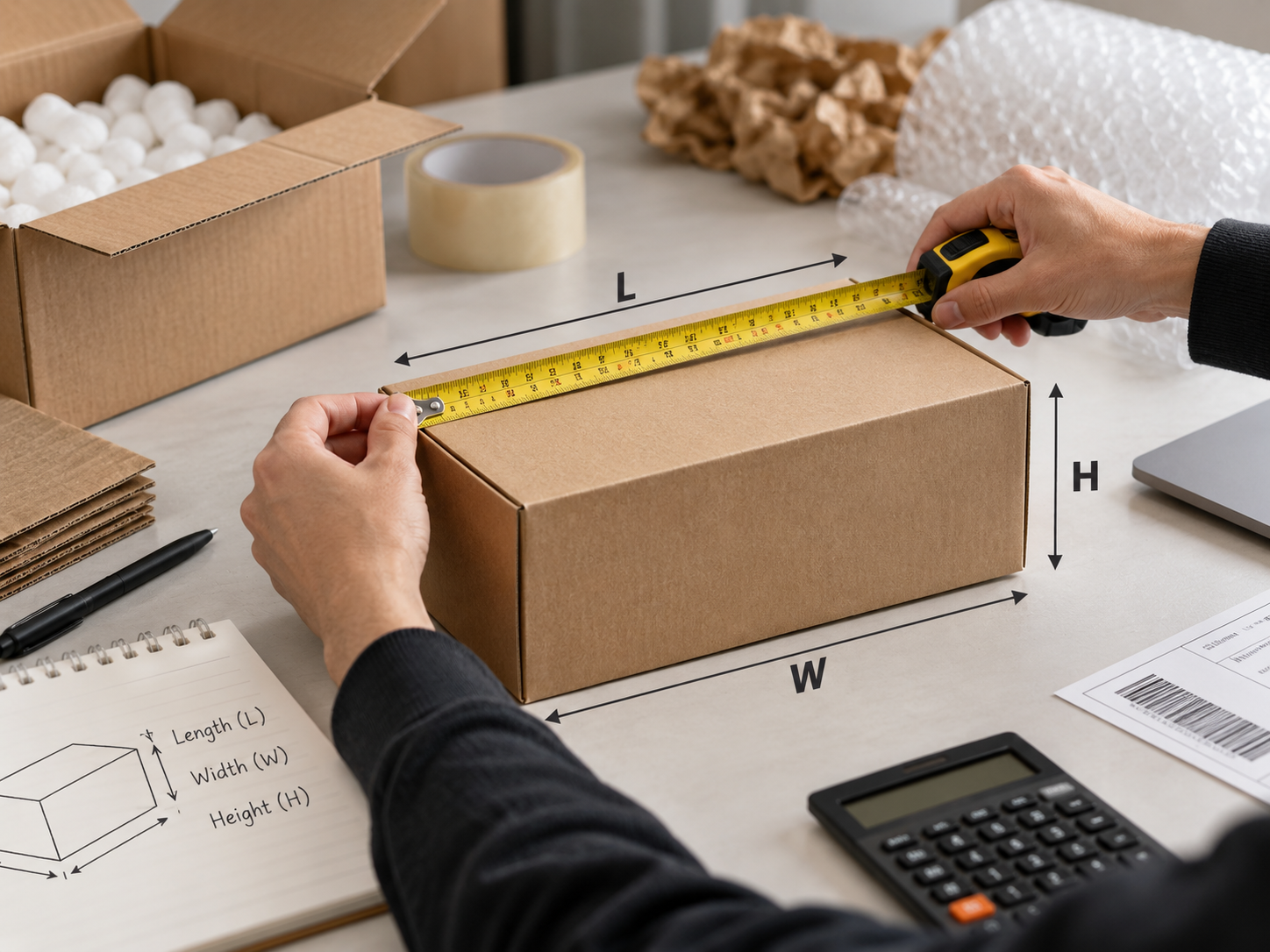
Measuring a packaging box involves establishing its length, width, and height (L × W × H) in sequence, either from an existing box or from the product you need to package. To determine the usable space for the product, measure the internal dimensions of an existing box, or measure the external dimensions when you need its overall size for storage, handling, or shipping. To size a new box, measure the product at its longest, widest, and highest points, then allow sufficient space for padding, inserts, dividers, or other protective materials. Record all measurements using the same unit while considering the product’s orientation and the required measurement format.
The required box dimensions need to accommodate the product along with any padding, inserts, dividers, or other protective materials. The space needed around the product depends on the type and thickness of these protective materials, as well as the required level of protection. The box material and construction then determine how much additional space is occupied by the box walls, with single-wall and double-wall corrugated boxes creating different internal and external dimensions because of their different thicknesses and strength levels. These factors determine the final internal space and overall box dimensions needed to package the product correctly.
The final dimensions can be used to calculate box volume, showing the available space inside or outside the box based on the measurements taken. Box size also affects dimensional weight, shipping costs, warehouse storage, palletisation, and manufacturing, making accurate sizing important beyond achieving a proper product fit. Accurate measurements support custom dieline development and help ensure the finished box meets the required specifications. The final dimensions should balance product fit, protection, material use, storage, transport, and manufacturing needs, whether you are choosing a standard box or custom packaging boxes.
What are Packaging Box Dimensions?
Packaging box dimensions are the three measurements used to describe the size of a packaging box in a specific sequence: Length × Width × Height (L × W × H). Length is the longest horizontal measurement of the box, while width is the shorter measurement from one side to the other of the box. Height refers to the vertical measurement from the bottom of the box to the top.
Box dimensions are used to measure the internal and external size of a box. Internal dimensions show the usable space available for the product, while external dimensions indicate the overall space required for storage and dispatch. Use the specified dimension order, box orientation, and measurement units to keep the measurements consistent and accurate.
Order of Dimensions: The order of dimensions refers to the sequence used to record a box’s length, width, and height, standardly used in the order of Length × Width × Height (L × W × H).
Box Orientation: Box orientation is the position of a packaging box during measurement, which determines how its length, width, and height are identified and recorded.
Measurement Units: Measurement units are the standardised units such as millimetres (mm), centimetres (cm), and inches (in) used to measure a box’s length, width, and height.
How Does Wall Thickness Affect Internal and External Box Dimensions?
Wall thickness affects box dimensions by changing the amount of space available inside the box and the box’s external size. Boxes with thicker walls reduce the internal space and keep the external dimensions the same. Maintaining the same internal space with thicker walls requires larger external dimensions to accommodate the additional material. Thinner walls create a smaller difference between the internal and external dimensions.
Boxes with different wall thicknesses are used for different packaging purposes. The effect of wall thickness varies with the packaging material and box construction. Packaging boxes like paperboard cartons have thinner walls and are used for lightweight products and retail packaging. Corrugated boxes have thicker walls because their liners and fluting add material to the box structure. The thicker walls of corrugated boxes make them suitable for products that need greater strength and protection.
How Does Corrugated Board Construction Affect Dimensions of Packaging Boxes?
Corrugated board construction determines the difference between a box’s usable internal space and its overall external dimensions through the thickness of its material. A thicker board reduces the available internal usable space inside the box and keeps the external dimensions the same. A thinner board creates a smaller difference between the internal and external dimensions.
Flute size and wall construction in corrugated board construction affect the overall thickness, strength, and dimensions of the box. A and C flutes have taller wave profiles that provide cushioning and compression strength while creating a thicker board structure. B, E, and F flutes have smaller profiles that create thinner board structures and can allow more compact box dimensions.
Corrugated wall boards are of two types: one is single-wall and the second is double-wall corrugated board. Single-wall corrugated board has one fluted layer between two liners, while double-wall corrugated board has two fluted layers with additional liner material, creating a thicker and stronger structure. Choose the right corrugated board thickness for the required internal space, product protection, storage, and dispatch, particularly when selecting corrugated packaging boxes for shipping and handling.
Single vs. Double-Wall Boxes
Single-wall and double-wall corrugated boxes differ in their construction, strength, typical use, dimensions, and level of protection. Select double-wall boxes when your product is heavy, bulky, or fragile and needs greater strength and protection. Choose single-wall boxes for lightweight products that need standard protection.
The differences between single- and double-wall boxes are summarised in the below given table.
| Construction | Single-Wall Boxes | Double-Wall Boxes |
| Strength | It provides sufficient structural strength for everyday cartons and standard shipping applications. | It provides higher rigidity and load-bearing strength for demanding packaging applications. |
| Typical Use | Single-wall boxes are commonly used for lightweight products, retail cartons, and general shipping boxes. | Double-wall boxes are commonly used for heavier products, bulky items, and products requiring additional cushioning and structural support. |
| Dimensions | A thinner board in single-wall boxes results in a smaller wall thickness. and more usable internal space within the same external box size. | A thicker board in double-wall boxes increases wall thickness, creating a greater difference between internal and external box dimensions. |
| Protection | It provides basic protection against handling, compression, and stacking during routine distribution. | It provides enhanced protection against compression, stacking pressure, impacts, and heavier handling conditions. |
How to Measure Packaging Box Dimensions for Your Product?
Measure your product at its longest, widest, and highest points to determine the packaging box dimensions needed for a proper fit. Add extra space for padding and inserts, depending on the protective material used. Account for board thickness, and check the final dimensions against the required orientation, units, and packaging specifications to get an accurate packaging box for your product.
Follow these steps to measure your product accurately and calculate the internal box dimensions needed for a proper fit.
- Gather Required Tools: Use a tape measure for larger boxes, a ruler for smaller boxes, and a calliper when precise measurements are needed for small products or components.
- Place Your Product: Position the product on a flat, stable surface in its correct position so its length, width, and height can be measured consistently.
- Measure the box dimensions: Measure the product’s length, width, and height at its longest or widest points. Keep the product in its intended orientation and record all measurements using the same unit.
- Allow for protective space: Consider any padding, inserts, wrapping, or cushioning required to protect the product. Include the space these materials will occupy when determining the box size.
- Calculate the Required Internal Box Dimensions: Add the product dimensions to the space needed for padding, inserts, or other protective materials. This gives you the approximate internal length × width × height (L × W × H) required for the box.
- Account for board thickness: Consider the wall thickness of the box material when converting between internal and external dimensions. Thicker materials, such as some corrugated constructions, create a greater difference between the usable internal space and the box’s external size.
- Verify the measurements: Confirm the supplier’s required dimension order, orientation, units, and rounding convention, and check whether the quoted dimensions are internal or external.
Avoid common measurement errors by checking the product orientation, required clearance, wall thickness, and whether the dimensions are internal or external. Common mistakes include measuring the wrong side of the box, forgetting space for protective packaging, using different units, and overlooking board thickness. Use consistent units and follow the supplier’s measurement requirements to ensure accurate box dimensions.
How Much Extra Space to Leave for Padding & Inserts?
Allow approximately 1-2 inches of extra space inside the box for padding, inserts, dividers, and the protection required by the product. The required clearance depends on the type and thickness of the cushioning material, the product’s fragility, and the amount of protection needed. Adjust the space inside the box according to the packaging material and protection.
A product measuring 200 × 150 × 50 mm would require approximately 210 × 160 × 60 mm of internal box space when 5 mm of bubble wrap is added to each side. Inserts and dividers may require additional clearance, while irregular products should be measured at their longest, widest, and highest points, including protruding areas that need protection. The resulting internal box dimensions should provide enough room for the cushioning system without leaving excessive space or compressing the product.
How to Calculate Packaging Box Volume?
To calculate the volume of the packaging box, measure the box’s length, width, and height using the same unit. Multiply these dimensions (length × width × height) of the box with the same units to calculate the volume of the box.
Box Volume = Length × Width × Height
The result represents the amount of three-dimensional space enclosed by the box, with the unit of the measurements you used. For example, a box with measurements of 12 × 8 × 6 inches has a volume of 576 cubic inches (12 × 8 × 6 = 576). Volume results can be measured in cubic centimetres (cm³), cubic inches (in³), cubic feet (ft³), cubic yards (yd³), and litres.
Measuring box volume helps you to determine how much space the box provides for the product and how much space the packaging box occupies during storage and transport. Use box volume to assess its dimensional weight. A larger package occupies more space during transport and can result in higher shipping charges.
Standard Box Sizes & Dimension Charts
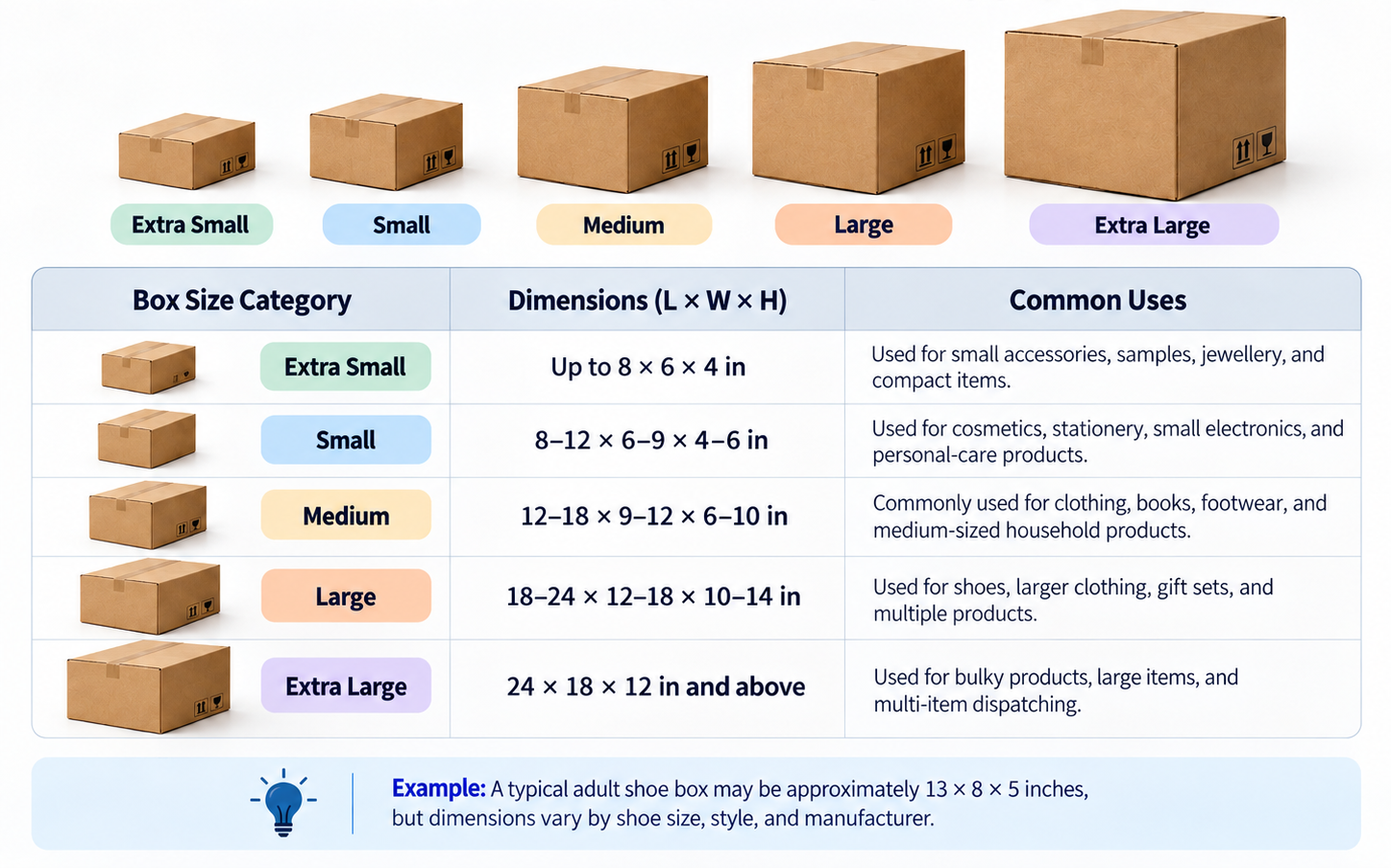
Standard box sizes are commonly available packaging dimensions grouped into categories such as small, medium, large, and extra-large. It is specified by length × width × height (L × W × H) and varies by packaging type and packaging requirements. Dimension charts give you a comparison between different box sizes so you can choose the right one for your product. Box size helps you select packaging that fits the product properly, while its dimensions determine the space available for the product, padding, and handling.
The table below provides approximate size ranges as a general reference for common packaging needs.
| Standard Box Size | Typical Dimension Range (L × W × H) | Use for |
| Extra Small | Up to 8 × 6 × 4 in | It is used for small accessories, samples, jewellery, and compact items. |
| Small | 8-12 × 6-9 × 4-6 in | It is used for cosmetics, stationery, small electronics, and personal-care products. |
| Medium | 12-18 × 9-12 × 6-10 in | Commonly used for clothing, books, footwear, and medium-sized household products. |
| Large | 18-24 × 12-18 × 10-14 in | Used for shoes, larger clothing, gift sets, and multiple products. |
| Extra Large | 24 × 18 × 12 in and above | Extra-large boxes are used for bulky products, large items, and multi-item dispatching. |
Example: A typical adult shoe box may be approximately 13 × 8 × 5 inches, but dimensions vary by shoe size, style, and manufacturer.
How to Choose the Right Packaging Box Type?
Choose the right packaging box by matching the box type and construction to the product’s dimensions, weight, fragility, presentation needs, and shipping conditions.
- Measure product dimensions to determine the required internal length, width, and height of the box.
- Allow space for padding, inserts and dividers to provide sufficient internal space for product protection and positioning.
- Assess product weight to determine the required board strength and box construction, particularly for heavier products.
- Identify product fragility to determine the level of cushioning, protection and structural support required during handling and transport.
- Consider shipping conditions such as stacking, compression, impacts, moisture and repeated handling when selecting the box construction.
- Match presentation needs with a suitable box type, such as a mailer box, folding carton, rigid box or another presentation-focused structure.
- Match the box type and construction to the product’s dimensions, weight, fragility, presentation needs and shipping conditions.
Packaging presentation influences whether custom mailer boxes, folding cartons, rigid boxes, or other presentation-focused structures are more suitable.
Mailer boxes are suitable for lightweight products and e-commerce orders, while shipping cartons and corrugated boxes provide added protection for products that require strength during handling and transportation. Shipping cartons are commonly used for dispatching electronics, clothing, and household products. Folding cartons are lightweight and commonly used for retail packaging, while rigid boxes provide a stronger, premium structure for products that require durability and presentation. Custom rigid boxes are generally used for luxury cosmetics, skincare, perfumes, jewellery, and watches where product presentation and structural protection are important. Custom boxes can be designed around specific product dimensions and packaging requirements.
Multiscore Boxes: One Box, Multiple Depths
Multiscore boxes use multiple score lines to create adjustable depth, allowing the same box to fit products with different heights. The box can be folded at the appropriate score line to change its internal depth while keeping the length and width the same. Multiscore boxes can accommodate different product sizes in one box, reducing the number of box SKUs and warehouse space while maintaining a closer fit around the product.
How Do Box Dimensional Weight & Size Affect Shipping Costs?
Dimensional weight can cost you more than the actual weight by occupying more space during shipping, which can increase the shipping charge even if the package is relatively lightweight. Dimensional weight & size are carrier-billing methods that consider the space a package occupies during transportation, not just its actual weight. It is calculated using the box’s length, width, and height, so a large box containing a lightweight product can have a higher dimensional weight. Carriers use dimensional weight to determine the billable weight and shipping cost.
Carrier-specific rules determine the dimensional-weight divisor, size limits, and calculation method. Some carriers also use girth, which combines the package’s width and height with its length to apply size limits. Tape or strapping secures the box during handling, while branded tape can add a simple branding element to the shipment.
Choosing the right box size reduces space and unnecessary shipping costs while still protecting the product. Proper sealing with tape or strapping keeps packages secure, while branded tape can add a simple branding opportunity. Consider box dimensions for warehousing and palletisation as well as shipping, while custom mailer boxes can provide a more branded packaging option.
Frequently Asked Questions
How do box dimensions affect warehousing and palletisation?
Box dimensions affect warehousing and palletisation by determining how efficiently packaging can be stored, stacked, and arranged on pallets. Consistent box dimensions make it easier to stack cartons securely, use available warehouse space efficiently, and create stable pallet loads.
How do box dimensions affect packaging manufacturing?
Box dimensions affect packaging manufacturing by determining the size, proportions, and panel layout of the finished box. Accurate dimensions ensure that the manufactured box provides the required internal space and matches the specified external size.
What units are box dimensions usually measured in?
Box dimensions are usually measured in millimetres (mm), centimetres (cm), or inches (in) and are commonly written as Length × Width × Height (L × W × H).
Should box measurements be rounded up or down?
Box measurements should generally be rounded according to the packaging supplier’s specified convention and the required product fit. Rounding down can reduce the available internal space and make the box too small for the product or protective materials. Rounding up provides additional clearance where needed.
Why do “tall” and “long” boxes sometimes get mixed up?
Terms such as tall and long can confuse because they describe a box’s appearance or orientation rather than fixed dimensions. UK packaging orders should use Length × Width × Height (L × W × H) and clearly identify each measurement to ensure accurate sizing and consistent specifications.
What does “girth” mean when sizing a box for shipping?
Girth measures the distance around the width and height of a box, rather than its length. It is calculated using 2 × (Width + Height), which measures the two width sides and two height sides around the package. Shipping carriers may use girth together with the box’s length when setting parcel size limits or calculating shipping charges.
How do you measure an irregularly shaped product for packaging?
Irregularly shaped products should be measured at their longest, widest, and highest points, including any protrusions that require protection. These maximum measurements establish the minimum internal space needed, while additional clearance should be allowed for padding, inserts, or dividers before determining the final internal box dimensions.
What’s the difference between kraft paper and test paper liners?
Kraft paper liners are generally stronger and more durable, making them suitable for corrugated boxes that require greater strength and performance. Test paper liners are typically a more economical option and can be suitable for less demanding packaging applications. The liner choice can therefore affect the box’s strength, durability, and overall packaging performance.
Do I need extra clearance for soft or compressible products?
Yes, you need extra clearance for soft or compressible products when designing packaging, shipping boxes, or manufacturing tolerances. Soft or compressible items can expand, shift, or deform under pressure. The box should provide enough room to prevent unwanted compression while keeping excess space to a minimum.
Can packaging tape be branded or printed?
Yes, branded or printed packaging tape can be used to add company branding while securely sealing boxes. Branded packaging tape provides a simple way to reinforce brand visibility across e-commerce and B2B packaging.
What are the standard dimensions of a shoebox?
Standard shoebox dimensions vary by shoe size, style, and manufacturer, so there is no single size that applies to every pair. A typical adult shoe box may measure around 13 × 8 × 5 inches (L × W × H), while larger or smaller footwear may require different dimensions. Custom shoe boxes should be sized according to the actual footwear dimensions, with additional space for tissue paper, inserts, or protective materials where required.
How is a box’s dimensional accuracy checked before production?
Box dimensional accuracy is checked by verifying the approved dimensions and dieline against the packaging specifications. Key measurements, fold positions, closures, and finished box dimensions are then verified to help ensure the box meets the required specifications before manufacturing.